Chain-of-Thought vs Zero-Shot: Which Should You Use?
 Dmytro Chaban
You've probably experienced this: you ask an LLM a simple question and get a perfect answer. Then you ask something slightly more complex, and it completely falls apart. Confident tone, wrong answer.
The difference often isn't the model. It's your prompting strategy.
After spending months testing different prompting approaches in LLMx Prompt Studio across real development work, I've found that choosing between zero-shot and Chain-of-Thought (CoT) prompting can mean the difference between a 60% success rate and a 95% success rate on complex tasks. But what most guides won't tell you: CoT isn't always better. Sometimes it's slower, more expensive, and complete overkill.
So when should you use each approach?
Key Takeaways#
- Zero-shot is fast, cheap, and achieves 85-95% accuracy on simple classification/extraction tasks
- Chain-of-Thought costs 2-5x more tokens but improves accuracy 20-40% on complex reasoning
- Rule of thumb: If a junior developer would need to think through it, use CoT
- Thinking models (Claude extended thinking, o-series, GPT-5.2 reasoning) already do CoT internally—don't double up
- Decision tree: Simple task? Zero-shot. Math/logic/debugging? Chain-of-Thought.
- Cost at scale: 10,000 daily requests = $30/day (zero-shot) vs $100/day (CoT)
TL;DR: Zero-Shot vs Chain-of-Thought#
- Zero-shot wins for simple classification, data extraction, and high-volume tasks where speed matters
- Chain-of-Thought wins for math problems, debugging, multi-step reasoning, and anything requiring logic
- Cost difference: CoT typically uses 2-5x more tokens than zero-shot for the same task
- Accuracy trade-off: CoT improves accuracy by 20-40% on complex reasoning tasks, but shows minimal improvement on simple ones
- Rule of thumb: If a junior developer could solve it without thinking hard, use zero-shot. If they'd need to work through it step by step, use CoT.
What is Zero-Shot Prompting?#
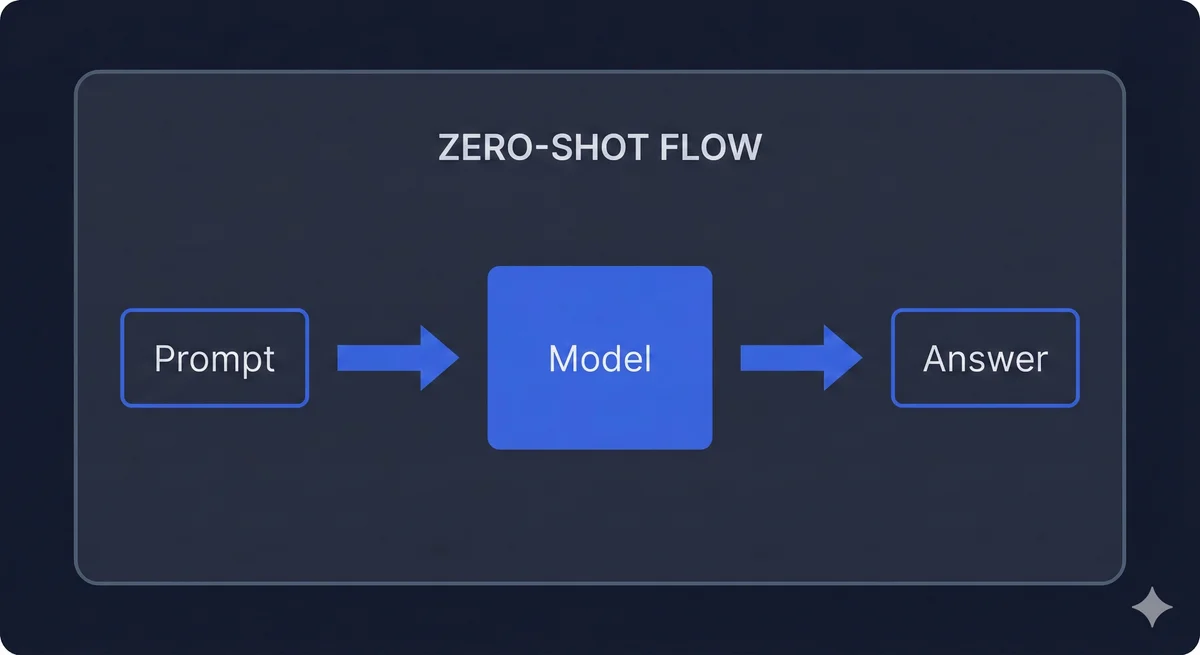
Zero-shot prompting is exactly what it sounds like: you give the model a task with zero examples. Just the instruction and the input.
A zero-shot prompt looks like this:
Classify the following customer review as positive, negative, or neutral:

"The product arrived on time but the packaging was damaged. The item itself works fine though."

Classification:
The model receives no examples of how to classify reviews. It relies entirely on its pre-trained knowledge to understand what you want and execute.
When Zero-Shot Works Best#
Zero-shot excels when:
- The task is well-defined and common (sentiment analysis, summarization, translation)
- Speed matters more than nuance (processing thousands of items)
- The output format is simple (single word, yes/no, category selection)
- You're working with clear, unambiguous inputs
In my testing, zero-shot handles about 70-80% of typical development tasks just fine. Simple code explanations, basic refactoring suggestions, documentation generation, obvious bug identification. All work without any fancy prompting.
Where Zero-Shot Falls Apart#
The problem hits when tasks require reasoning, especially with non-thinking models and open-source LLMs. Frontier "thinking" models (like Claude with thinking or OpenAI's 5.2) have built-in reasoning that mitigates this, but most lightweight models you'll use in production don't have that luxury. Ask a standard model to calculate something with multiple steps using zero-shot, and watch it confidently produce the wrong answer. Ask it to debug a complex issue, and it'll jump to conclusions without considering the full picture.
Classic example where zero-shot fails with lightweight models like Ministral 3B, SmolLM3-3B, or Llama 4 Scout 8B:
Question: A store sells apples for $2 each. If you buy 5 or more, you get 20% off the total.
How much do 7 apples cost?

Answer:
With zero-shot, these models frequently output $14 (7 × $2) and completely ignore the discount. They see numbers, do basic math, and move on. No reasoning, no consideration of the conditional logic. The correct answer is $11.20.
What is Chain-of-Thought Prompting?#
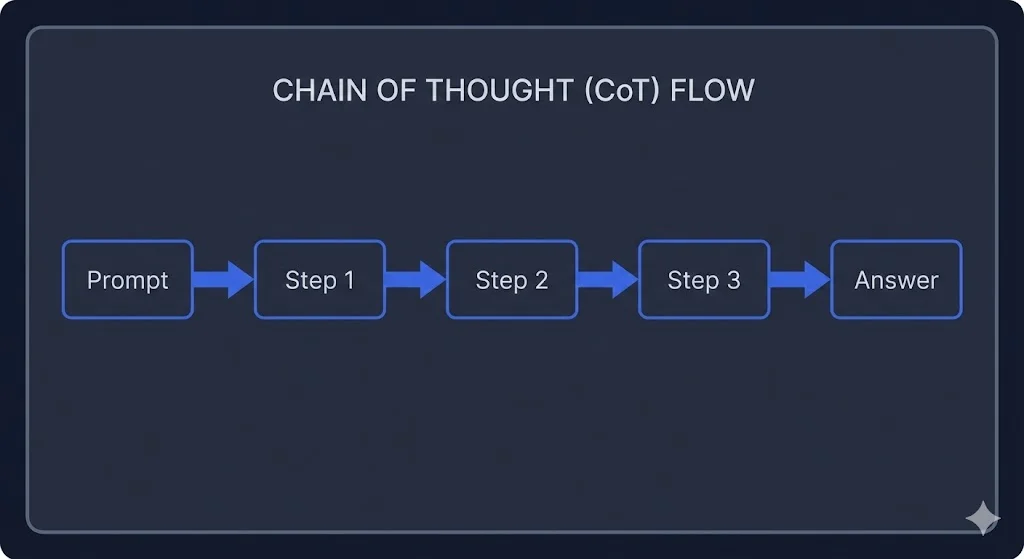
Chain-of-Thought prompting forces the model to show its work. Instead of jumping straight to an answer, it reasons through the problem step by step.
The simplest way to trigger CoT is adding a single phrase:
Question: A store sells apples for $2 each. If you buy 5 or more, you get 20% off the total.
How much do 7 apples cost?

Let's work through this step by step:
Now watch what happens:
Let's work through this step by step:

1. First, calculate the base price: 7 apples × $2 = $14
2. Check if the discount applies: 7 apples > 5, so yes, the 20% discount applies
3. Calculate the discount: $14 × 20% = $2.80
4. Subtract the discount from the total: $14 - $2.80 = $11.20

The 7 apples cost $11.20.
Same model. Same question. Completely different (and correct) result.
How Chain-of-Thought Actually Works#
CoT works because it:
- Breaks complex problems into smaller chunks the model can handle individually
- Keeps intermediate results visible so the model doesn't "forget" earlier calculations
- Mirrors human problem-solving which the model learned from training data
- Catches logical errors by making each step explicit and reviewable
LLMs are better at many small reasoning steps than one big reasoning leap. CoT exploits this by decomposing problems.
Variations of Chain-of-Thought#
A few CoT variations worth knowing:
- Simple CoT: Add "Let's think step by step" or "Let's work through this"
- Structured CoT: Explicitly define the steps you want ("First, identify X. Then, calculate Y. Finally, determine Z.")
- Zero-shot CoT: Just the trigger phrase, no examples
- Few-shot CoT: Provide 1-3 examples showing the reasoning process before your actual question
For most development tasks, zero-shot CoT (just the trigger phrase) works well enough. You don't always need elaborate examples.
Zero-Shot vs Chain-of-Thought: Head-to-Head Comparison#
What I've observed across hundreds of prompts in real development scenarios (tracked and compared side-by-side in Prompt Studio):
| Factor | Zero-Shot | Chain-of-Thought | |--------|-----------|------------------| | Speed | Fast (single inference) | Slower (longer output) | | Token Usage | Low (100-500 tokens typical) | High (300-2000 tokens typical) | | Cost per Request | ~$0.001-0.01 | ~$0.003-0.05 | | Simple Task Accuracy | 85-95% | 85-95% (no improvement) | | Complex Task Accuracy | 50-70% | 80-95% | | Debugging/Logic Tasks | Often fails silently | Usually catches errors | | Explainability | None (just the answer) | Full reasoning visible | | Best For | Classification, extraction, generation | Math, logic, debugging, analysis |
The accuracy numbers come from my testing across coding tasks, but they align with published research. Google's original CoT paper showed similar patterns: minimal improvement on simple arithmetic, but dramatic gains on multi-step problems.
The Cost Reality#
Real numbers matter when choosing prompting strategies. Using Claude Sonnet 4.5 pricing ($3 input / $15 output per million tokens)—for more on model pricing, see our budget coding LLM comparison:
Zero-shot code review prompt:
- Input: ~200 tokens
- Output: ~150 tokens
- Cost: ~$0.003
CoT code review prompt (same task):
- Input: ~250 tokens
- Output: ~600 tokens
- Cost: ~$0.01
That's roughly 3x the cost for the same task. For a single request, irrelevant. For 10,000 daily requests? That's $30/day vs $100/day. The difference adds up fast.
Real-World Use Cases: When I Use Each#
After integrating both approaches into my daily workflow, this is how I actually use them:
Zero-Shot Wins: Simple Classification and Extraction#
Code smell detection:
Identify any obvious code smells in this function. List them briefly:

[code]
Works with zero-shot. The task is well-defined, the model knows what code smells are, and I just need a quick list.
Data extraction from logs:
Extract all error codes from these logs. Return only the codes, one per line:

[logs]
Zero-shot. Fast, accurate, no reasoning needed.
Quick documentation:
Write a brief docstring for this function:

[code]
Zero-shot handles this fine. Common task, well-understood by the model.
Chain-of-Thought Wins: Complex Debugging#
Diagnosing a bug:
This function should return the sum of even numbers, but it's returning incorrect results for some inputs.

Let's debug this step by step:
1. First, trace through the logic with a simple example
2. Identify where the actual behavior differs from expected
3. Explain the root cause

[code]
CoT matters here. Without it, models often suggest fixes without understanding the actual problem. With CoT, they trace through the logic and find the real issue.
Architecture decisions:
I need to choose between Redis and PostgreSQL for session storage in a high-traffic web app.

Let's analyze this systematically:
1. List the key requirements for session storage
2. Compare how each option handles these requirements
3. Consider the trade-offs for our specific use case
4. Make a recommendation with reasoning

Context: 50,000 concurrent users, sessions expire after 30 minutes, need to store ~2KB per session.
Zero-shot would give you a surface-level answer. CoT walks through the actual trade-offs and produces a reasoned recommendation.
Code refactoring decisions:
This function is 200 lines long and handles multiple responsibilities.

Let's think through the best refactoring approach:
1. Identify the distinct responsibilities in this code
2. Determine logical boundaries for separation
3. Consider dependencies between the parts
4. Propose a refactoring strategy that minimizes risk

[code]
Complex refactoring requires understanding relationships and dependencies. CoT forces the model to analyze before suggesting changes.
The Gray Area: It Depends#
Code review: For obvious issues (missing null checks, unused variables), zero-shot is fine. For subtle logic errors or design problems, CoT catches more.
Test generation: Simple unit tests work with zero-shot. Complex integration tests or edge case identification benefit from CoT.
API design: Basic CRUD endpoints, zero-shot. Complex domain modeling, CoT.
Decision Framework: Which Should You Use?#
The framework I use every time:
Use Zero-Shot When:#
- Task has a single, clear answer (classification, yes/no, extraction)
- No multi-step reasoning required (the answer is "obvious" to a trained model)
- You're processing high volumes (cost and speed matter)
- Output format is simple and well-defined
- The task is extremely common (summarization, translation, basic code generation)
Use Chain-of-Thought When:#
- Problem involves math or calculations (even simple ones, if accuracy matters)
- Task requires comparing multiple options (architecture decisions, trade-off analysis)
- Debugging or root cause analysis (need to trace through logic)
- Multi-step processes (anything with "first do X, then Y, then Z")
- You need to verify the reasoning (explainability matters)
- The model keeps getting it wrong with zero-shot (this is your signal to switch)
Quick Decision Tree#
Is the task simple classification or extraction?
  → YES → Use zero-shot
  → NO → Continue

Does it involve math, logic, or multi-step reasoning?
  → YES → Use Chain-of-Thought
  → NO → Continue

Is the model consistently getting it wrong with zero-shot?
  → YES → Try Chain-of-Thought
  → NO → Stick with zero-shot

Is explainability/auditability important?
  → YES → Use Chain-of-Thought
  → NO → Use zero-shot (faster/cheaper)
Cost and Performance Optimization#
Some strategies for optimizing prompts in production:
Batch Similar Tasks#
If you're processing many items, group by complexity. Run simple extractions with zero-shot in bulk, then run complex analysis with CoT separately.
Cache CoT Reasoning#
For repeated similar problems, the reasoning steps are often reusable. Cache the chain-of-thought for common problem types and adapt for specific instances.
Model Selection Matters#
Smaller models benefit more from CoT than larger ones. If you're using a frontier model (Claude Sonnet 4.5/Opus 4.5, GPT-5.2), zero-shot works better than you'd expect. If you're using a smaller model for cost reasons, CoT becomes more important for maintaining accuracy.
Note on thinking models: If you're using models with built-in reasoning (Claude with extended thinking, OpenAI's o-series, GPT-5.2 in reasoning mode), CoT provides diminishing returns. These models already do internal chain-of-thought before responding. Adding explicit "think step by step" prompts is redundant and just burns tokens. Save CoT for non-thinking models where you need to externalize the reasoning process.
Chain-of-Thought vs Zero-Shot - FAQ
Zero-shot is your default. It's fast, cheap, and handles most tasks well. But when you hit reasoning tasks, math, debugging, or complex analysis, Chain-of-Thought is worth the extra tokens. Know when to switch.
Start simple. Escalate when needed. Test both approaches on your specific use case. Tools like LLMx Prompt Studio make it easy to compare results side-by-side and track what works. The "best" strategy depends on what you're building.