Kimi K2.5 vs Claude Sonnet 4.5: The $60 vs $200 Model Comparison (2026)
 Dmytro Chaban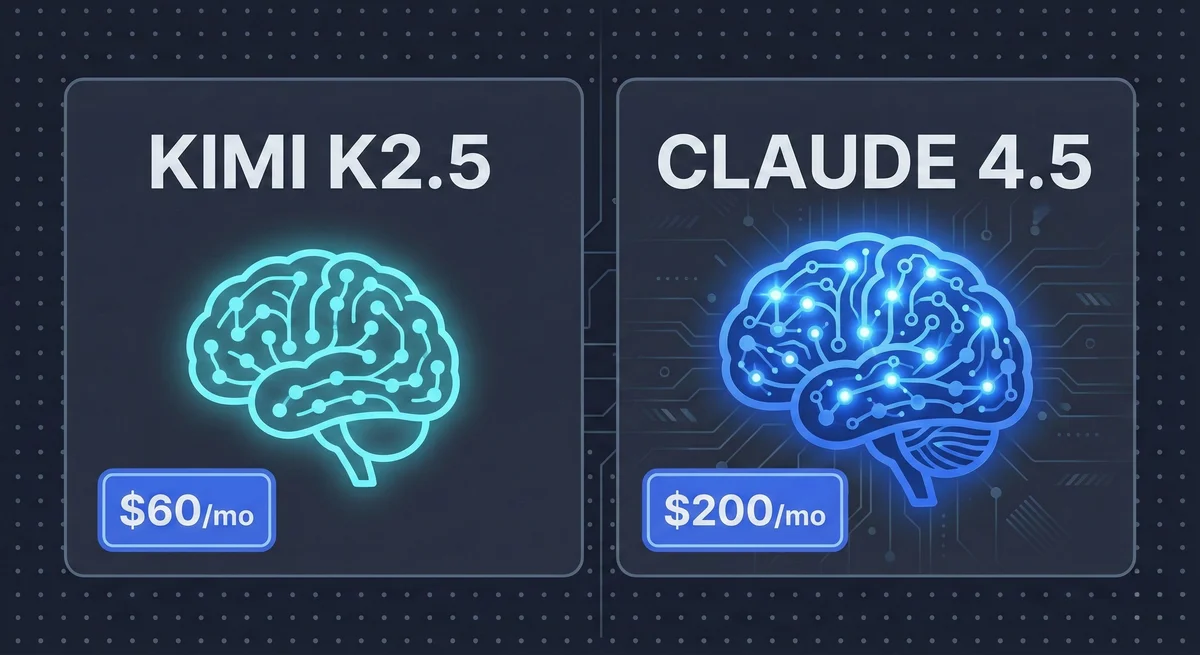
After one month of intensive daily coding with both Kimi K2.5 and Claude Sonnet 4.5 (plus testing with Claude Opus 4.5), I didn't just run benchmarks; I actually built stuff. From routine refactoring to hair-pulling debugging sessions, I threw everything at these models. The marketing departments want you to believe there's a clear hierarchy: Claude at the top, everyone else trailing behind. But the reality is messier—and more interesting.
Look, I'll be honest: Claude Sonnet 4.5 is objectively the better model. It's smarter, less annoying with edge cases, and handles complex logic with a grace that Kimi K2.5 sometimes lacks. But "better" is only part of the story. Because Kimi K2.5 costs 70% less and performs at roughly 80-90% of Claude's level for most real-world coding tasks.
The question isn't "which model is best?" It's "how much are you willing to pay for that last 10-20%?"
TL;DR: Kimi vs Claude Model Comparison#
- Best Value: Kimi K2.5 via OpenCode ($60/mo) delivers ~90% capability for 30% of the price.
- Best for Professionals: Claude Sonnet 4.5 ($200/mo) is the reliable workhorse with superior tooling.
- The Intelligence Gap: Kimi excels at routine coding; Claude wins on complex architecture and deep debugging.
- Hidden Gem: Claude Opus 4.5 (included in $200 plan) remains unmatched for reasoning tasks.
- Bottom Line: Start with Kimi ($60). Upgrade to Claude ($200) only if the extra 10-20% capability saves you billable hours.
The Models: A Quick Breakdown#
Claude Sonnet 4.5 & Opus 4.5: Anthropic's Flagships#
Let's break down exactly what we're looking at. Claude Sonnet 4.5 (released late 2025) is Anthropic's workhorse model—fast, capable, and designed for production use. Claude Opus 4.5 is the heavy hitter, slower but significantly more capable on complex reasoning tasks.
Claude Sonnet 4.5
Developer: Anthropic
Fast, reliable workhorse model designed for production coding and daily tasks. Excellent at code generation, debugging, and general reasoning.
Specifications
Claude Opus 4.5
Developer: Anthropic
The heavy hitter for complex reasoning. Slower, more expensive, but unmatched for architecture, novel problems, and deep debugging.
Specifications
When you subscribe to Claude Code at $200/month, you're getting unlimited access* to both models. Sonnet 4.5 handles the bulk of tasks; Opus 4.5 steps in when you need maximum capability.
*Note: "Unlimited" has fair usage policies, but in practice, they are extremely hard to hit for a single user.
Kimi K2.5: Moonshot AI's Challenger#
Kimi K2.5 is Moonshot AI's latest reasoning-focused model, positioned as a competitor to Claude Sonnet 4.5. It emphasizes tool use and agentic capabilities, making it particularly interesting for coding workflows. If you are exploring budget coding LLMs, Kimi is a top contender alongside DeepSeek.
Kimi K2.5
Developer: Moonshot AI
Reasoning-focused model optimized for agentic workflows and tool use. punches above its weight class with strong execution capabilities.
Specifications
Here's what makes Kimi K2.5 interesting: It punches above its weight class on tool-augmented tasks. When given access to search, code execution, and external APIs, Kimi K2.5 closes much of the gap with Claude Sonnet 4.5. The model was clearly designed with agentic workflows in mind.
Head-to-Head: Model Performance Comparison#
Coding Tasks: The 80-90% Range#
In my extensive testing across multiple projects, Kimi K2.5 performs at roughly 80-90% of Claude Sonnet 4.5's level on standard coding tasks:
Where Kimi K2.5 matches Claude Sonnet 4.5:
- Writing CRUD operations and API endpoints
- Refactoring existing code
- Explaining code functionality
- Writing unit tests
- Standard debugging scenarios
- Documentation generation
Where Kimi K2.5 falls behind:
- Complex architectural decisions
- Debugging subtle race conditions
- Understanding implicit constraints in legacy codebases
- Novel problem-solving (tasks without clear patterns)
- Multi-step reasoning chains
Where Claude Opus 4.5 pulls ahead significantly:
- Complex system design from scratch
- Debugging mysterious production issues
- Understanding and modifying unfamiliar frameworks
- Tasks requiring deep contextual awareness across large codebases
- Creative solutions to novel problems
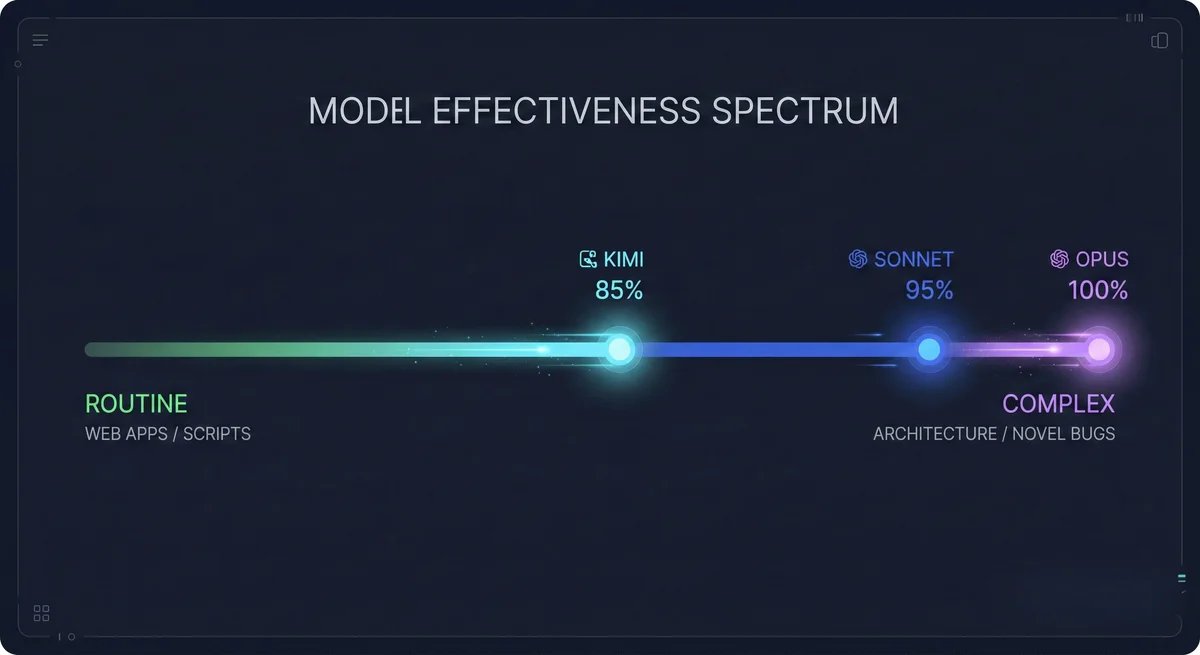
The pattern is clear: routine coding work shows minimal difference between Kimi K2.5 and Claude Sonnet 4.5. The gap widens as complexity increases, with Opus 4.5 maintaining a decisive lead on the hardest tasks.
Benchmark Reality Check#
While I focus on real-world testing, the benchmarks tell a similar story:
Benchmark Performance Comparison
| Model | Context | Input Price | Output Price | Monthly Cost* | Aider Score | Value Score ⬇️ |
|---|---|---|---|---|---|---|
| 🥈 Kimi K2.5 | 256K | - | - | $60 | ~71% | 0.85 |
| 🥇 Claude Sonnet 4.5 | 200K | - | - | $200 | ~77% | 2.59 |
| 💎 Claude Opus 4.5 | 200K | - | - | $200 | ~85% | 2.35 |
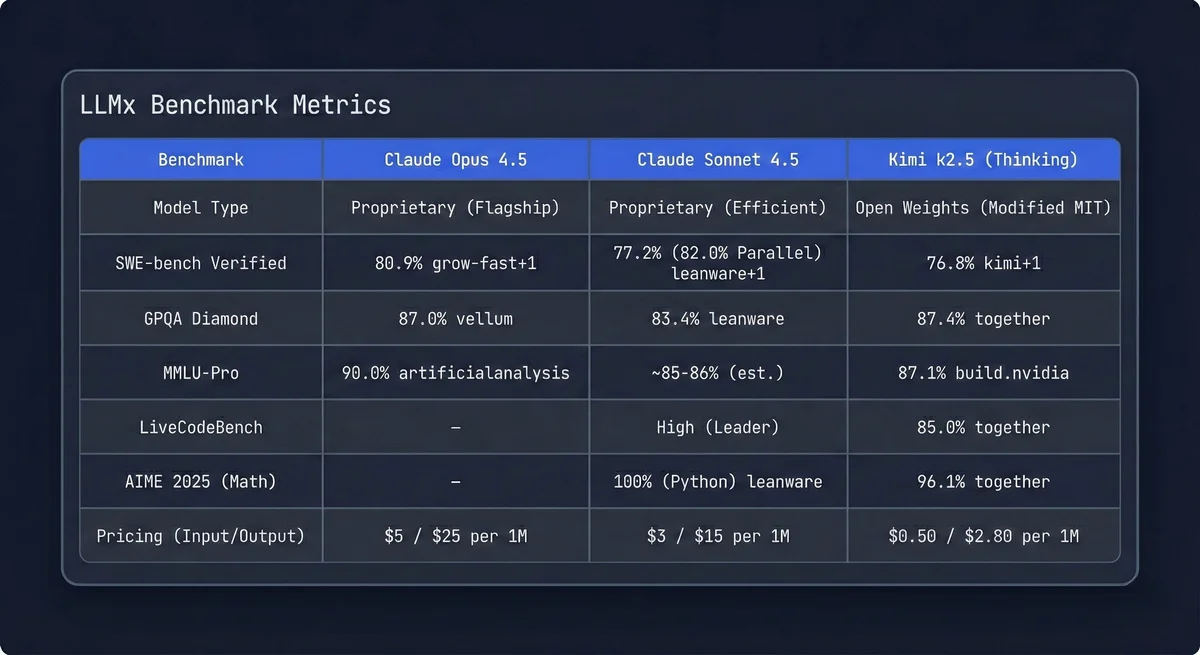
The Reality: On standard benchmarks, Kimi K2.5 is competitive with Claude Sonnet 4.5, trailing by 4-6 percentage points. Against Opus 4.5, the gap widens to 10-14 points. These differences sound small, but they translate to meaningful real-world friction—more retries, more manual intervention, more time spent prompting carefully.
Agents & Tools: Who Actually Listens?#
This is the weird part. Kimi K2.5 was built for agentic workflows. When given access to tools—web search, code execution, external APIs—Kimi often outperforms expectations. If your goal is to be 10x more productive with agents, this model is surprisingly capable for the price.
In my testing:
- Web research tasks: Claude Code's web search tool is significantly better—more reliable, better source quality (comparable to dedicated search tools), and less prone to getting stuck in loops
- Multi-step tool chains: Kimi shows strong execution discipline
- Context persistence: Kimi maintains state well across long agent sessions
However, Claude Opus 4.5 remains the gold standard for complex agentic workflows requiring nuanced decision-making. When the task requires judgment about which tools to use and when, Opus's superior reasoning shows.
The Tooling Gap: Why Claude Feels Premium#
Claude Code: Premium Model + Premium Interface#
When you pay $200/month for Claude Code, you're not just buying access to Claude Sonnet 4.5 and Opus 4.5. You're buying a polished, AI-ready environment. You're buying:
- Best-in-class permission management: Granular, contextual approvals that don't break flow
- Intelligent context handling: Better use of the 200K context window
- Seamless integrations: Higher success rate with external tools and APIs
- Parallel execution: Run multiple agents without thinking about rate limits
The model is excellent. The tooling around it is even better.
OpenCode with Kimi: Good Model, Adequate Interface#
OpenCode gives you access to Kimi K2.5, but the experience differs significantly:
- Permission management: Functional but clunky compared to Claude Code
- Context handling: Kimi's 256K window is larger, but Claude Code uses context more effectively
- Integration reliability: More friction with external services (Vertex AI is a notable pain point)
- Rate limits: Better than Claude's pricing tiers suggest, but UX is rougher
The model is 80-90% as good. The tooling is more like 70% as good.
The Math (Because It's My Money)#
Accessing Claude Sonnet 4.5 & Opus 4.5#
Claude Code Pricing Tiers
| Model | Context | Input Price | Output Price | Monthly Cost* | Aider Score | Value Score ⬇️ |
|---|---|---|---|---|---|---|
| ❌ Claude Pro | 200K | - | - | $20 | Baseline | N/A |
| ⚠️ Claude Max Std | 200K | - | - | $100 | 5x Limits | N/A |
| ✅ Claude Max Premium | 200K | - | - | $200 | 20x Limits | N/A |
The $20 tier is a trap. You'll burn through it in 30 minutes of active coding. Realistically, you need $100 minimum, preferably $200 to access Opus 4.5.
Accessing Kimi K2.5#
Kimi K2.5 Pricing Providers
| Model | Context | Input Price | Output Price | Monthly Cost* | Aider Score | Value Score ⬇️ |
|---|---|---|---|---|---|---|
| 🥉 Moonshot Moderato | 256K | - | - | $19 | Extended | N/A |
| 🥈 Moonshot Allegretto | 256K | - | - | $39 | 2x Limits | N/A |
| 🥉 Synthetic.new Standard | 256K | - | - | $20 | 135/5hr | N/A |
| 🥇 Synthetic.new Pro | 256K | - | - | $60 | 1350/5hr | N/A |
The $60 tier on Synthetic.new is the sweet spot: You get 50% higher rate limits than Claude's $200 tier, accessing a model that's 80-90% as capable. That's the value proposition in a nutshell.
Real Cost Comparison#
Scenario: Solo developer, 40 hours/week coding
Interactive Cost Comparison: API Pay-Per-Token vs Subscriptions
Claude Sonnet 4.5 via Claude Code ($200/month):
- Model performance: 100% (baseline)
- Tooling UX: Excellent
- Rate limits: Comfortable
- Monthly cost: $200
- Cost per hour of AI assistance: ~$1.25
Kimi K2.5 via Synthetic.new ($60/month):
- Model performance: ~80-90% of Claude
- Tooling UX: Good but clunky
- Rate limits: Excellent (higher than Claude)
- Monthly cost: $60
- Cost per hour of AI assistance: ~$0.38
The question: Is that 10% performance difference worth paying 3.3x more? For many developers, the answer is no.
Real-World Performance: When Each Model Wins#
Kimi K2.5 Excels At:#
Standard web development: Building CRUD apps, REST APIs, frontend components. Kimi generates clean, working code that rarely needs major revision. The gap with Claude Sonnet 4.5 is minimal here.
Routine refactoring: Renaming variables, extracting functions, moving code between files. Kimi handles these tasks competently, often matching Claude's output quality.
High-volume workflows: When you need to process many files or run many queries, Kimi's superior rate limits (at 1/3 the price) become a massive advantage.
Budget-conscious projects: When every dollar matters, Kimi delivers professional-grade results at a fraction of the cost.
Claude Sonnet 4.5 Excels At:#
Complex debugging: When you're tracking down subtle bugs—race conditions, memory leaks, edge cases—Sonnet 4.5's superior reasoning saves real time.
Unfamiliar codebases: Sonnet 4.5 is better at understanding implicit assumptions and tribal knowledge in legacy code.
Integration work: Higher success rate with external APIs, services, and complex authentication flows.
Claude Opus 4.5 Excels At:#
Architecture decisions: Designing systems from scratch, evaluating trade-offs, predicting future pain points. Opus's reasoning depth is unmatched.
Novel problems: When there's no established pattern to follow, Opus 4.5's creativity shines.
Production debugging: Mysterious production issues requiring deep investigation and lateral thinking.
Code review: Catching subtle issues that other models miss.
Decision Framework: Which Model for Which Developer?#
Choose Kimi K2.5 If:#
- You're doing standard development (web apps, APIs, scripts)
- 80-90% accuracy is sufficient for your work
- Budget is a primary concern
- You need high volume usage
- You're comfortable with slightly clunkier tooling
- Most of your work is "routine" rather than "novel"
Choose Claude Sonnet 4.5 If:#
- You regularly encounter complex debugging scenarios
- Tooling quality directly impacts your productivity
- You work with unfamiliar codebases frequently
- The $140/month premium is insignificant in your context
- You need the best balance of capability and speed
Choose Claude Opus 4.5 If:#
- You're working on cutting-edge or novel problems
- You're an architect making high-level design decisions
- You need the absolute best reasoning capability
- Cost is truly no object
- Your work justifies the premium (e.g., high-stakes production systems)